Sunday, December 28, 2014

Conclusion

Hello everybody!


Thank you for keeping up with my posts on Your Emergency Preparedness Blog for the past 3 months.

Posting every week about emergency preparedness has been a really enjoyable experience!
I am glad that I was able to be committed to finishing a goal I have started by finishing this blog.

I would like to remind everyone that, although this blog is for YOUR convenience, it does not have all the material necessary for a more complete emergency preparedness.

Most of my posts on this blog are drawn from the LA Fire Department Emergency Preparedness Booklet, so please make sure to look at the full booklet for further emergency readiness.

I hope that my blog has been a source of help to you in your emergency preparation!

Until next time,

Nahyung


Be ready. Now.
Your Emergency Preparedness

Sunday, December 21, 2014

Last Post: Week 12

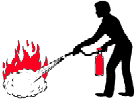
How to Extinguish Fires on your Body


Have you ever hear of the phrase "Stop, Drop, and Roll"? 
This method of rolling on the floor to extinguish flames on your body is actually effective for most fires.

Although your initial reaction when your body gets caught on fire may be to run to grab a fire extinguisher (or simply panic), flames can actually travel across your body in seconds
By the time you have began running towards a fire extinguisher or for help, it may be too late.


image source: Arizona Firewise

So, why Stop, Drop, and Roll?
If you've ever wondered why we should do that instead of grabbing for a fire extinguisher,
Here are 3 reasons why Stop Drop, and Roll is quite effective:

1) Remember the Fire Triangle that I posted a few weeks ago, and that fire needed oxygen to burn on? You must Stop because if you are running when your body is on fire, that running motion will only give the fire more oxygen (making the fire bigger).

2) Dropping down to the floor in a horizontal position changes the direction of
 the fire. Fire burns up vertically, which means that it is likely to head for your lungs or your face, which are the most sensitive parts of your body. But if you lie down horizontally, you have twisted the direction of the fire so that it will be slower to reach your face or lungs.

3) Rolling is using the same principle of the Fire Triangle (that fire needs oxygen to burn on). By squishing the fire with your body through the rolling motion, you prevent the fire from feeding unto more oxygen in the air. Thus, the rolling motion allows your to put out the fire effectively.

The Stop, Drop, and Roll method is quite effective both when you are alone, or when you cannot get immediate help from a third party to extinguish the fire.

(Extra)

Thank you everyone for keeping up with my posts these past 3 months. Next week, I will conclude Your Emergency Preparedness Journal with a conclusion!


Get ready. Now.
Your Emergency Preparedness


Sunday, December 14, 2014

Week 11

Emergency Preparation at your Workplace

Hello everyone. It's already been almost three months since I started posting for Your Emergency Preparation Journal every week!  One more post to go!
Until then, let's keep it up!

Since we've talked a bit about emergency preparation at home, let's talk about emergency preparation at work.

We've already talked about storing water and preparing an emergency backpack (although, the emergency backpack can also be used at your workplace). Storing flashlights (not candles or matches, since they can cause fires) in a reachable spot should also be a must.

The checklist below shows the types of items that could be used as survival tools at your workplace. It is basically the same as the list for your emergency backpack, except that when you're preparing for an emergency at your workplace, you should be aware that you may be trapped inside a building for long periods of time (up to 3 days), and so you should be prepared for this.

So here is the checklist:


Again, like most of my sources, this checklist is drawn from the LA Fire Department Emergency Preparedness Booklet. To access the full booklet, here is the link:
http://www.cert-la.com/EmergPrepBooklet.pdf

Get ready. Now.
Your Emergency Preparedness


Sunday, December 7, 2014

Week 10

What's the Most Important of All? Water.


Hello, it's me again.
Like the title of this post says, this week, I'm going to talk about the importance of storing water.

We always hear everywhere that you have to store water. That's because without water, you can't live.

According to the LA Emergency Preparedness Booklet, a "rule of thumb" for the amount of water that should be stored is: 5 Gallons per person, MINIMUM.
(Your pets should be thought of as family members when storing water).

Also, many people don't know this, but if you are storing water with plastic water bottles,  do not place them on top of concrete. 


image source: cosmos.ucdavis.edu

This is because the chemicals from the concrete can enter the water through the thin plastic and contaminate it.

So those are just some facts about storing water for emergency preparation.

See you again next week!


Get ready. Now.
Your Emergency Preparedness


Sunday, November 30, 2014

Week 9

Emergency Preparedness with Your COMMUNITY


Last week I talked about the basics of preparing for emergencies with your family.
This week will be a continuation of that post -- being prepared with your community around you.

It is good to be connected with your neighbors (even if you don't like them) for times of emergencies.
This is because your community can provide you with food, shelter, and water during urgent times.
For example, your local high school building can become the temporary shelter to people who have lost their homes during an earthquake. 

A good tip to prepare for an emergency with your community is to: contact your local and state of Office of Emergency Services to find out the emergency plans in your area and where the emergency shelters are.

(Bonus)
Another tool I was introduced while I was at the CERT boot camp is Nextdoor.
Nextdoor is a phone app that connects you with your neighbors and makes communication easy.
It's totally free, and a good way to inform your neighbors of needs or dangers in your community.
It "reports suspicious activities, help[s] prevent crime, and receive[s] updates from [your] local police"!

So hey, just a good thing to try out. After all, we're living in the age of technology, right? Might as well make good use of it.

Here's the link to the NextDoor homepage: https://nextdoor.com/


Get ready. Now.
Your Emergency Preparedness


Sunday, November 23, 2014

Week 8

How to prepare for an emergency with your FAMILY


Hello! Last week I talked a bit about what action to take after an earthquake has taken place.

This week, let's discuss a bit about how to prepare for an emergency with your family.

After all, having a family member separated or injured from a natural disaster is terrible.

So, to prevent something like that happening, here's how to prepare for an emergency with your family (the basics):

1. Decide a meeting place together. That way, even if you are separated and there's chaos going on, you know where to find your family.

2. Prepare a backpack with equipments necessary after a natural disaster (such as first aid, toilet paper, water, flash light, working gloves, emergency blanket) and put it in a reachable spot around the house.
That way, when an earthquake (or any other disaster) happens, you can just grab the backpack and go. 

3. Look around the house to check for anything that can fall, break, or cause a fire during a disaster (or any other dangers), and remove if possible.

Of course, these are just the basics. 
For more information on emergency preparedness with your family, visit the City of Los Angeles Emergency Management Department: http://www.emergency.lacity.org/Readiness/FamilyReadiness/index.html  


Get ready. Now.
Your Emergency Preparedness


Sunday, November 16, 2014

Week 7

What do You do AFTER an Earthquake?


Last week, I talked about different methods of evacuation in different settings, such as outdoors.

This week, I would like to present what action to take after an earthquake has passed by.

Since earthquakes are so unpredictable, you may feel dazed or scared after an earthqake happens; and this is completely natural. 

But once your head becomes clearer, it's time to take a look around you to see what has happened, and if there are any new dangers around you, such as fires or broken debris that may have resulted from the earthquake.

Below is a checklist of things to make sure right after an earthquake has just happened.
Some of the check marks may be unnecessary, depending on where you are at the time of the earthquake. For example, if you are not at home during the time of the earthquake, you may be unable to to check for gas leaks at your home or to replace all telephone receivers for emergency only.

But here is the checklist:


The checklist is from the LA Fire Department Emergency Preparedness Booklet. Here is the full booklet online: http://www.cert-la.com/EmergPrepBooklet.pdf 


Get ready. Now.
Your Emergency Preparedness

Sunday, November 9, 2014

Week 6

Different Scenarios when You're in an Earthquake


Think of yourself in this situation: 
You were peacefully walking somewhere on the streets, when suddenly, the ground underneath you begins violently shaking. What will you do?

Or how about this scenario:
You are inside a high-rise building, when suddenly, you feel an earthquake shaking the building. What should you do?

Many of us have only been taught what to do in an earthquake as high school students. And because of this, we only know how to evacutate inside school buildings: to duck under a desk, and cover your head and neck.
Of course, this method isn't wrong. In fact, this method should work anywhere most of the time.

However, the problem is that we don't know what action to take when we face an earthquake out of a school or office building. 

So today, I decided to show the different methods of evacuation, depending on the environment (out on the streets, in high-rise buildings, driving, and more) you are placed in.


And here they are:


This picture is a page from the LA Fire Department Emergency Preparedness Booklet. You can find the full booklet here: http://www.cert-la.com/EmergPrepBooklet.pdf

Get ready. Now.
Your Emergency Preparedness

Sunday, November 2, 2014

Week 5

Do I Turn off the Gas Valve?

After an earthquake, we usually think that the gas will be leaking. 

Contrast to popular belief, however, the gas may not always leak after an earthquake.

Turn off the gas valve only if you smell the gas leaking.

This is because of two reasons:
1) If the gas isn't leaking, but you turn it off anyway, then you're only losing your source for fire and heat. 

2) To turn on a gas valve that has already been shut off, you must contact the gas valve company. If you attempt to turn it on by yourself, it can be very dangerous.

(Bonus)
How to tell if a gas valve is ON or OFF:
Gas Valve

image source: City of Rancho Palos Verdes


Get ready. Now.
Your Emergency Preparedness
Sunday, October 26, 2014

Week 4

What causes fires?

Have you ever heard of the Fire Triangle?

Fire Triangle
image source: sc.edu/ehs/modules/Fire/01_triangle.htm

Above, you see a picture of the "Fire Triangle." The Fire Triangle basically explains the materials necessary to cause or extinguish a fire.

As you can see in the picture above, you need oxygen, heat, and fuel to cause a fire. This means that if one of those sources are cut off, the fire will be extinguished.

Knowing this, fires can be extinguished easily, sometimes without the help of a fire extinguisher.

For example, if your food sets on fire while you're cooking on a frying pan, what do you do?
According to the Fire Triangle, simply closing the lid of the frying pan (limiting the source of oxygen), will extinguish the fire.

Keeping the Fire Traingle in mind can come in handy when facing a fire. But of course, let's not underestimage the dangers of a fire. If the fire is too big, it may be unmanagable. Let's not forget to call 9-1-1 in times of emergency.


Get ready. Now.
Your Emergency Preparedness

Sunday, October 19, 2014

Week 3

How to Use a Fire Extinguisher 

image source: ilpy.com

Since I talked about the types of fire extinguishers last week,
I thought that it would be important to talk about how to use them.

Recently, at a CERT (Community Emergency Response Team) boot camp, I learned about a simple way to remember how to use a fire 
extinguisher. It goes like this:

P - Pull. Pull the pin at the top of the extinguisher
A - Aim. Aim the nozzle towards the fire
S - Squeeze. Squeeze the handle to dispense the chemicals that extinguish the fire.
S - Sweep. Move the nozzle in a sweeping motion back and forth at the base of the fire.

Extinguishing the fire at its base is important, because a fire's source is at its base.


Now you know how to use a fire extinguisher!


Get ready. Now.
Your Emergency Preparedness


Sunday, October 12, 2014

Week 2

Remember the A, B, C's

Have you ever wondered what the Alphabet letter ratings on your fire extinguisher meant?

Well, the letters tell you what the fire extinguisher is effective for --

Class A fire extinguishers are effective for extinguishing fire on ordinary combustibles, such as wood, trash, textiles and plastic.

Class B fire extinguishers are effective for extinguishing fire on flammable liquids, such as cooking oil, gasoline, kerosine, or paint.

Class C fire extinguishers are effective for extinguishing fire on electric equipment, such as electrical outlets.

ABC Rated
image source: Steel Country Emergency


There are more types of fire extinguishers for different types of fires, which are explained here, on Steele County's Emergency website: 

http://www.steelecountyemergency.com/fire-extinguishers


Get ready. Now.
Your Emergency Preparedness


Sunday, October 5, 2014

Week 1: Introduction

HELLO EVERYBODY!


I live in California.
And if you didn't know, California is quite famous for being located on the Ring of Fire,
where a large number of volcano eruptions and earthquakes happen. 

Although California has not faced a huge earthquake since the Northridge Earthquake in 1994, every year, you'll hear somewhere that a "Big One" is coming soon. 
And it's probably true.

So why not prepare now? 

My name is Nahyung, and this will be my personal blog about emergency preparedness.


Every week, for three months, I'll post something helpful for your emergency preparedness.

So stay tuned!


Get ready. Now.
Your Emergency Preparedness